When Sonic Racing: Across the World launched this year, Sega positioned it directly Mario Kart World by promising faster tracks, bolder physics, and running comparison ads claiming to “outperform” the Nintendo icon. The campaign sparked curiosity online, reviving Nintendo Vs. The Sega feud is generating interest. It’s a thoroughly modern interpretation of a time-tested marketing strategy and partly leverages streaming to spread the word.
Compare that to Nintendo: A company that, while innovative, has been wary of adopting modern gaming marketing strategies. Nintendo maintains tight control over how its games are displayed and shared, so it’s surprising that Nintendo games still get so much organic interest (such as the incredibly extensive coverage for Switch 2 launch). In this article, we’ll compare the performance of Nintendo games against competitors with similar gameplay from other publishers to gauge who comes out on top in live streaming.
TL;DR Takeaways by Stream Hatchet:
- Comparing its best months, Nintendo’s games generated 10X the number of viewers compared to its competitors
- More than 20% of Nintendo’s game viewers consistently stream similar competing games when they are released
- Nintendo’s catalog of retro titles is growing viewership, accounting for more than 30% of the publisher’s viewership over the past 5 years
Nintendo Games Far Outperforms Its Competitors in Streaming
To try and get a fair comparison between Nintendo games and their competitors, we chose four pairs of games with very similar gameplay/creative origins and compared a series of metrics between the two games:
- Kart Racer: Mario Kart World vs. Sonic Racing: Across the World
- Party Games: Super Mario Party Jamboree vs. Lego Party!
- Monster Catching Game: Pokemon Red/Purple vs. Digimon Story: Time Stranger
- Platform Fighters: Super Smash Bros Ultimate vs. Aether II Rival
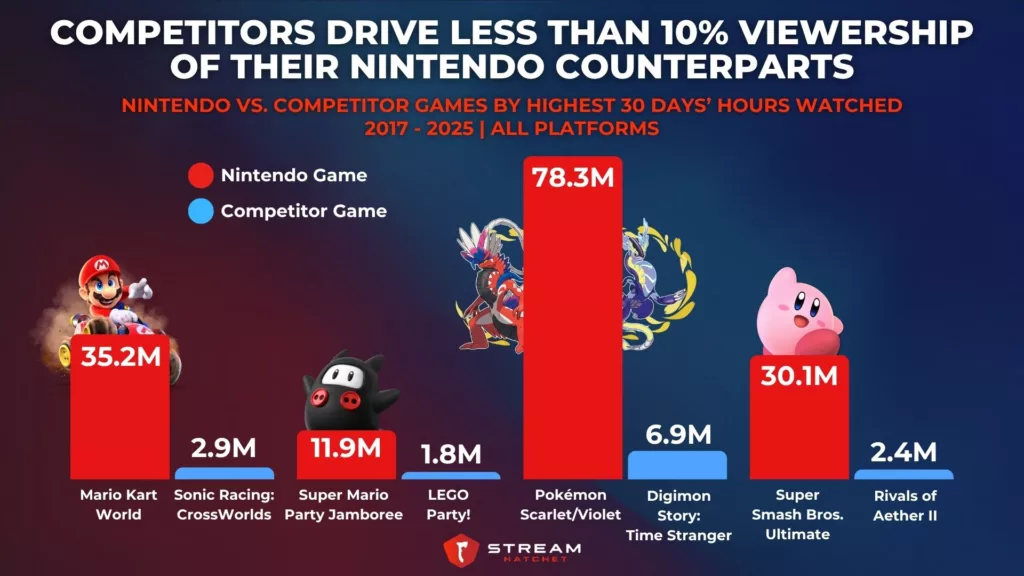
The result? Nintendo games beat their competitors in terms of pure viewership. Across all live streaming platforms, examples of Nintendo titles saw more than 10x the views of their competitors’ games during the 30-day peak period. Mario Kart World reaching 35.2 million hours watched during its peak 30-day window, compared to just 2.9 million hours for Sonic Racing: Across the World. Super Mario Party Jamboree surpass Lego Party! with the same ratio despite much lower viewership, and so too Super Smash Bros Ultimate compared with Aether II Rival. Pokemon Red/Purple had the highest hours watched (unsurprisingly) with 78.3 million hours watched, but received good reviews Digimon Story: Time Stranger6.9 million hours watched is very respectable.
So, Nintendo games are still the definitive version of the format for most livestream viewers… but have the tides turned?
How Viewers Switch Between Nintendo Games and Their Competitors
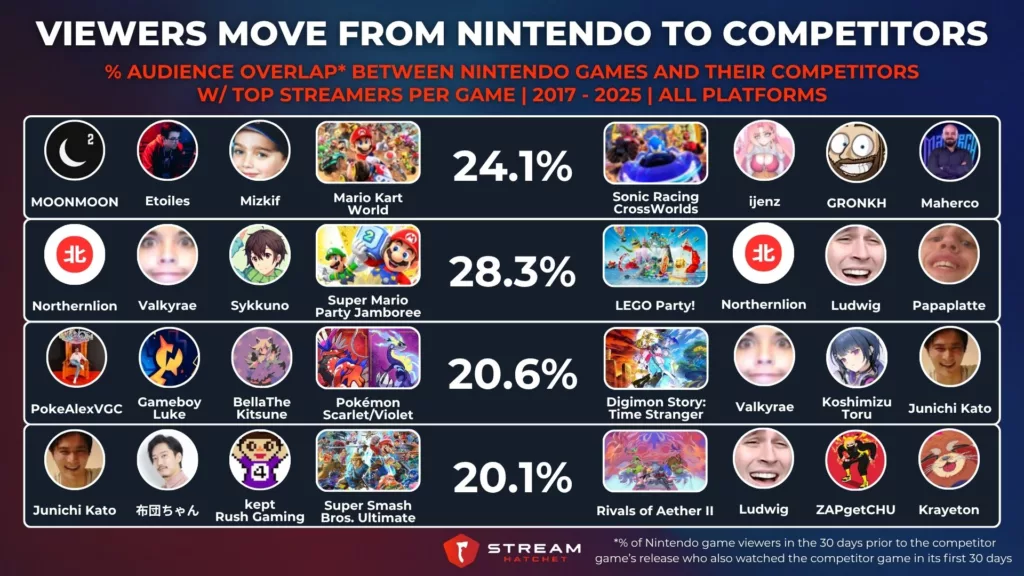
Even with certain gameplay styles that seem to hinder them, Nintendo’s audience is still open to exploring similar titles. In every example we look at here, more than 20% of viewers who watched a Nintendo game before a competitor’s game was released also watched a competitor’s game within their first month. For example, 24.1% of Mario Kart Worldthe audience watched Sonic Racing: Across the World in the first month, temporary Super Mario Party Jamboree has the highest overlap among the sampled games, approaching 30%. This curiosity is an opportunity for competitors to take advantage of it when releasing similar titles.
However, some of this overlap is not due to the game, but to the streamers covering the game. Take Northernlion, for example, which is the top streamer for both Super Mario Party Jamboree And LEGO Party! in the period examined: The audience followed it from one match to the next. You can see a similar publisher-agnostic stance from streamers like Valkyrae and Junichi Kato. Publishers have had to turn to well-known streamers in this format to access new audiences that have proven to be interested in their style of gameplay.
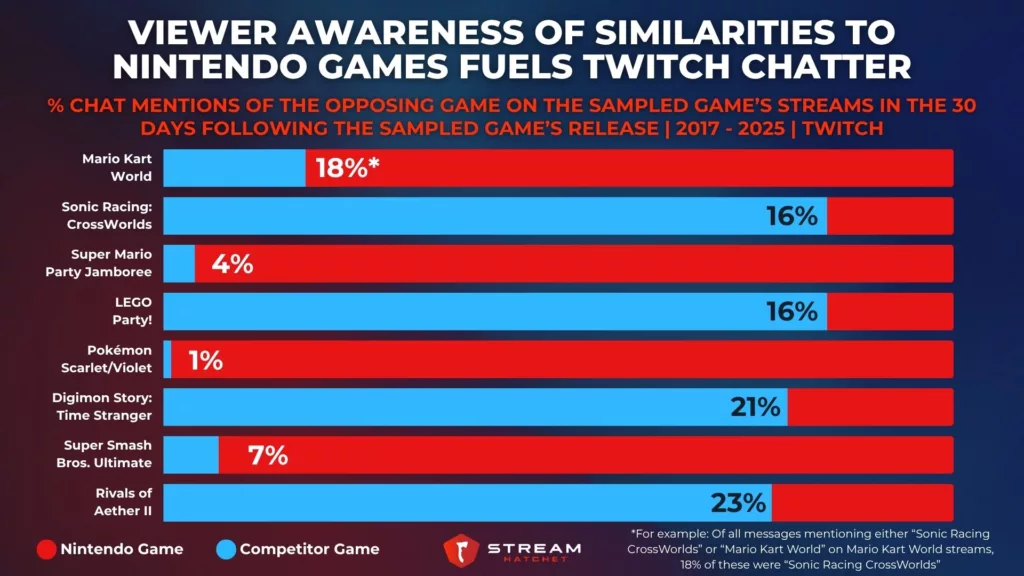
Twitch viewers are well aware of the similarities between these titles, and discussions on competitors’ streams often include direct references to Nintendo titles. Across the game sample, 16-23% of chat mentions that included at least one of the game titles referred to Nintendo games in competitor game streams. In other words, mentions of Nintendo games accounted for about a fifth of game mentions even in competitor streams. But if you look at Nintendo’s game stream, competitor mentions only account for 1-7%.
One interesting exception comes up with Sonic Racing: Across the WorldHowever. On Mario Kart World streaming, 18% of all chats mentioned one of the games referenced Sonic Racing: Across the Worldwhich is actually a higher share than vice versa. For once, a competitor managed to get people talking within the Nintendo ecosystem, a testament to Sega’s smart marketing strategy. Of course that means the conversation is framed in terms of comparison, but prefer this rather than shying away, at least leveling the playing field and putting Nintendo’s kart racers under the microscope as well.
Nintendo’s OG Status Is Backed By A Love Of Retro Games
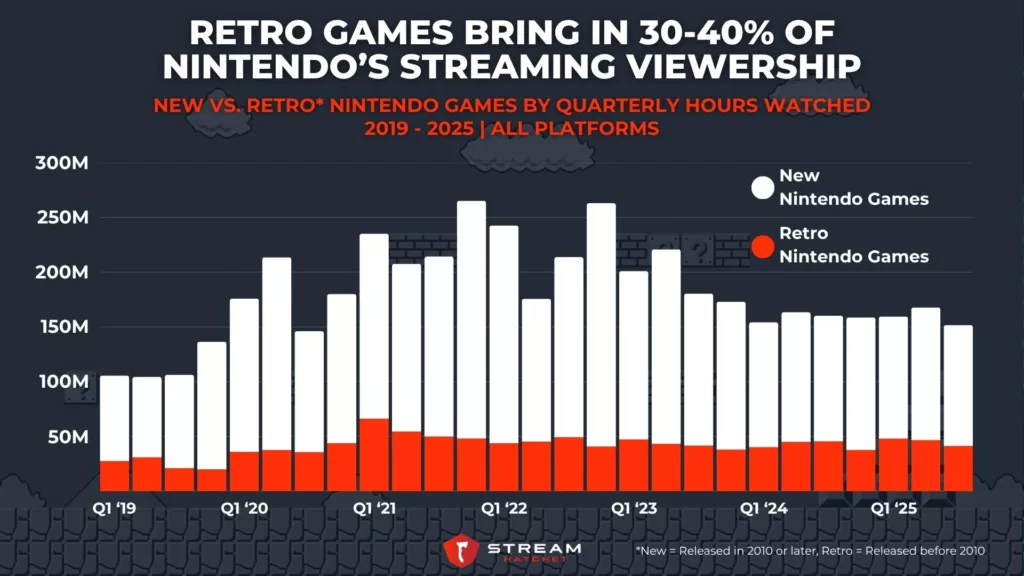
The power of Nintendo’s IP makes it difficult to shake as a benchmark for certain genres and gameplay styles. While competitors focus on the next big release, Nintendo’s greatest strength lies in its back catalogue. Over the past six years, Nintendo retro games (here defined as games released before 2010) have accounted for 30–40% of the publisher’s total live stream viewership.
This long-term retro audience base reflects more than just nostalgia: It shows the brand loyalty Nintendo has built over generations. While new titles create temporary spikes in attention, older Nintendo games provide a solid foundation that keeps the live streaming community engaged. This reputation helped the company weather the storm when one of their new titles received negative feedback.
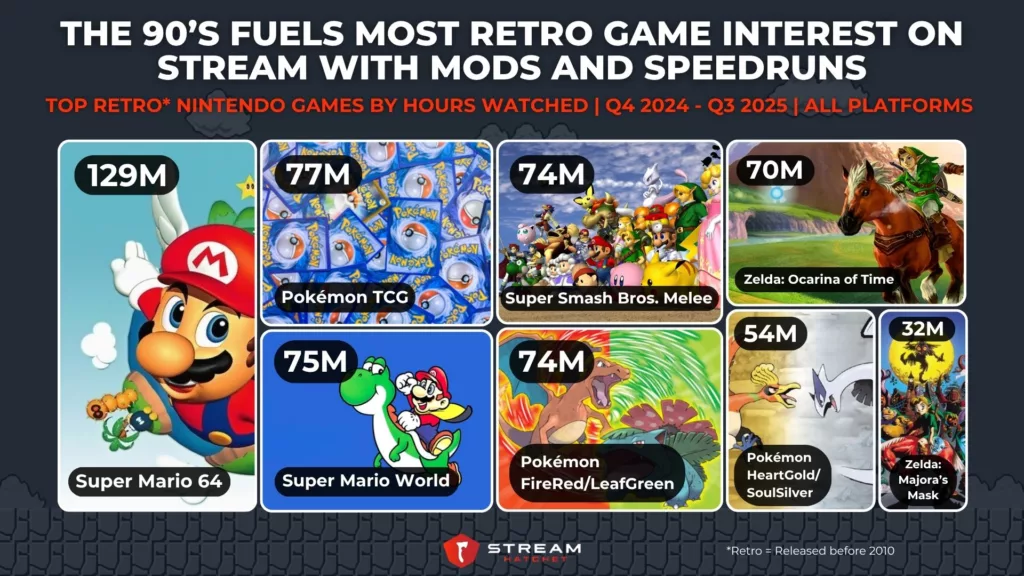
The foundation of live streaming support for Nintendo’s retro titles is set in one particular decade: the 90s. Looking at retro games based on hours watched over the past year, Super Mario 64 leading with 129 million hours watched, followed by another ’90s classic Super Mario World (75 million), Pokémon FireRed/LeafGreen (74 million, remade), Super Smash Bros Melee (74M), and Zelda: Ocarina of Time (70M). Together, these classic films formed a genre that still dominates today, even rivaling the annual viewing figures of some new releases.
Each of these games has also developed its own subculture on live streaming platforms that keeps the content fresh. Super Mario 64 fostering a passionate speedrunning and modding scene, while Super Smash Bros Melee sustaining one of gaming’s most enduring competitive communities. Pokémon FireRed/LeafGreen And Heart of Gold/Soul of Silver progress through nuzlocke challenges and randomizers, meanwhile Ocarina of Time And Majora’s Mask inspires story-based error displays and replays. This creative reinvention is an ever-evolving experience that continues to attract new audiences and entice old fans to return.
Differences in Nintendo and Sega’s Attitudes Towards Modern Games
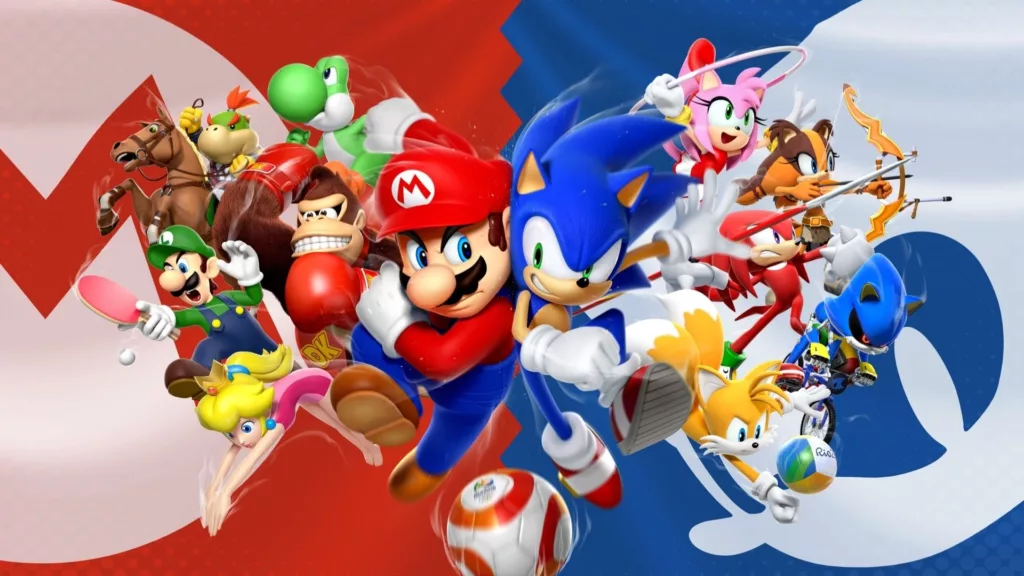
As the frontrunner here, Nintendo can rely on its legacy of providing support and fueling nostalgia to attract players. However, this also makes Nintendo very protective of its IP in general, especially when it comes to new games and online coverage of those games. Compared to other Japanese publishers, Nintendo has been reluctant to adopt modern forms of game marketing or reduce its intellectual property through collaborations with other franchises. (with exceptions like Super Smash Bros. fighter). The Nintendo Direct showcase is a perfect example of this philosophy: Nintendo led the way by moving their announcements online (innovation), but actively discouraged co-streaming of the event (skepticism of modern game marketing).
In contrast, Sega was much more experimental. With Sonic Racing: Across the WorldSega launched a campaign openly targeting Nintendo’s flagship kart racer, emphasizing cross-platform functionality, and incorporating collaborations with franchises such as SpongeBob SquarePants, Minecraft, and Pac-Man. This shows Sega is willing to prioritize visibility, influencer partnerships, and even controversy to gain attention. Where Nintendo relied on narrative control, Sega focused on adaptability: reaching new audiences through social collaboration and streaming culture.
_
Nintendo’s current dominance in live streaming is about more than just game design: It rests on heritage, fan trust, and a brand that streamers and viewers regard as a genuine standard. Although competitors are attracting interest, they are struggling to get out of Nintendo’s shadow…
But this could change. Sonic Racing: Across the World is one such disruptor: With aggressive marketing campaign targeting Mario Kart World straightforward and broad cross-franchise strategy, the game seeks to modernize its appeal. Sega’s kart racer went beyond simply copying the mechanics and significantly differentiated itself from Nintendo, then used modern game marketing techniques to reach an audience that Nintendo had not yet fully exploited. Building a community, streaming-friendly content, and a recognizable identity is of utmost importance, leaving room for competitors to build their own legacies in the years to come.
To stay up to date with the latest insights on live streaming, follow Stream Hatchet and receive exclusive, newsletter-only content:
News
Berita Teknologi
Berita Olahraga
Sports news
sports
Motivation
football prediction
technology
Berita Technologi
Berita Terkini
Tempat Wisata
News Flash
Football
Gaming
Game News
Gamers
Jasa Artikel
Jasa Backlink
Agen234
Agen234
Agen234
Resep
Cek Ongkir Cargo
Download Film
Originally posted 2025-12-17 14:14:23.